

Innovation is key to solving the water challenges with which the country grapples. This includes revolutionising construction practices to deliver critical municipal water infrastructure quicker and more cost-effectively. At the same time, these new builds need to be robust so that they continue to add value for many years with minimal maintenance and repairs. This has become an important consideration bearing in mind the premature degradation of many new reinforced concrete structures. In many of these instances, poor design; construction workmanship; and/or material use are at fault.
Precast concrete meets all these requirements and more, including the ability to execute projects in a safer manner by restricting work at height and by placing concrete in a setting that can be controlled more easily than on a worksite. Then there is the smaller carbon footprint of industrious precast-concrete operations. To remain competitive, enterprising fabricators use energy, water and materials judiciously. This is in addition to the innovative deployment of admixtures and materials to produce concrete mixes with lower cement content. These ultra-strength mixes, together with the sophisticated curing processes deployed in a controlled factory environment, also facilitate the manufacture of high quality prefabricated concrete elements that are less susceptible to corrosion. This, in turn, reduces carbon emissions from maintenance and repair operations over the lifecycle of the structure. Add to this the optimal use of materials and more efficient designs that would be too costly or complicated to execute on site. For example, hollow-core slabs require 45% less concrete and 30% less reinforcing steel than a standard cast-in-place concrete slab.
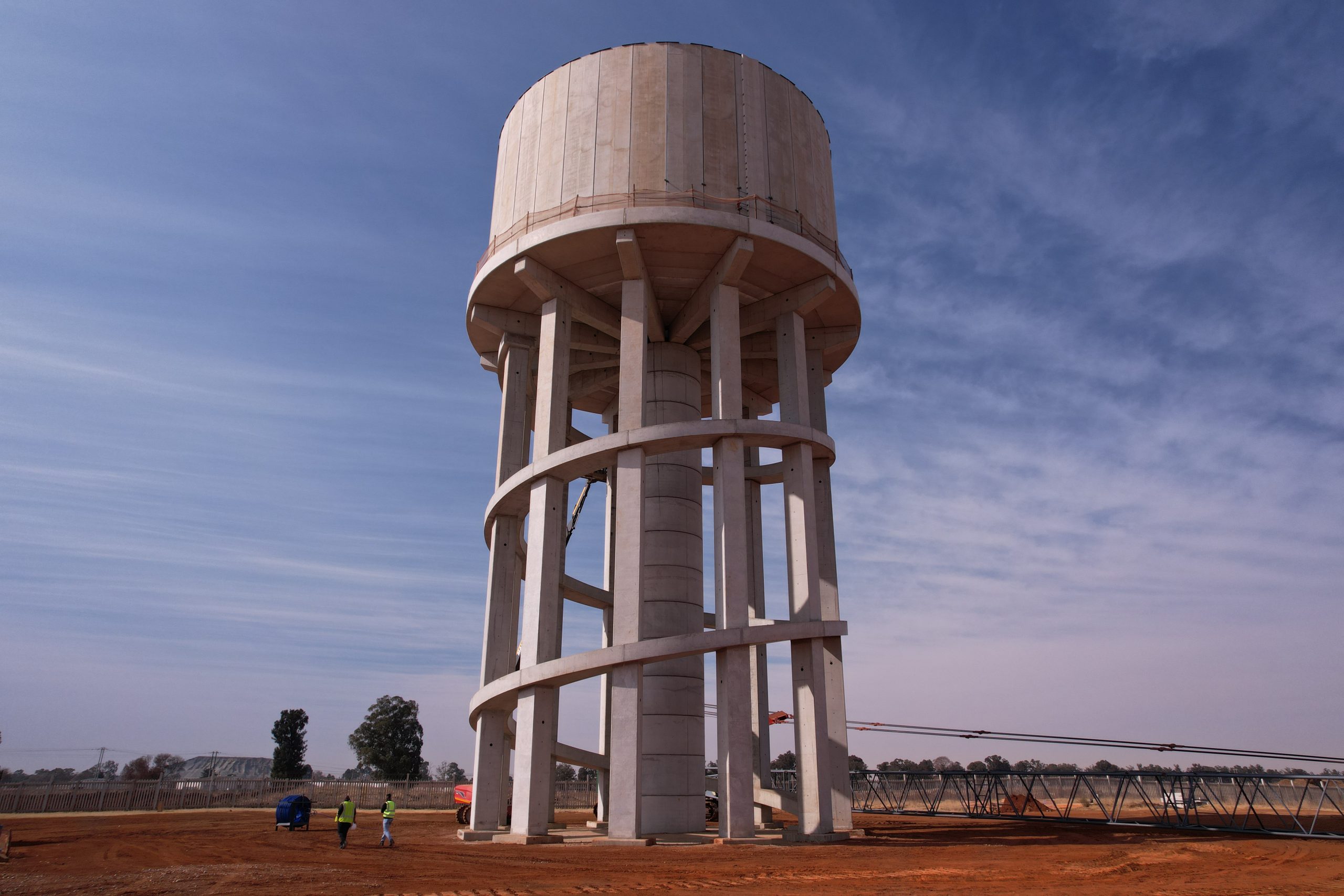
This method of construction has proven itself time and again when building reservoirs and, more recently, two water towers, among the latest innovation in precast concrete from a recognised leader in the field, Corestruc. These are the first water towers to be constructed using this modular method that is based on a uniquely South African design.
They have also been built in record time in areas plagued by water shortages. For example, together with site clearing, earthworks and the construction of the foundation of one of these water towers was completed in only between 10 and 12 months. It would have taken between two and three years to complete similar sized structures of the same quality using traditional cast-in-place concrete construction methods. As more municipalities and their engineers specify this method of water tower construction in jurisdictions, Corestruc will have an opportunity optimise its processes even further to construct these structures much faster. This is similar to the way in which it has perfected the construction of prefabricated reservoirs over the years. The entire precast concrete value chain including design, manufacture, transport logistics and construction have been optimised.
The 18m-diameter prefabricated tanks, each with a 2,5ML of water-storage capacity, are supported 34m above ground level by an innovative precast concrete structure, consisting of columns, beams and hollow-core slabs. It is founded on a one-metre-thick cast-in-situ raft with cast-in-stub columns that can withstand seismic action.
A standout feature of both towers is the spiral beam that provides critical support to the columns. However, it fulfils an even more important role than its striking aesthetic value by providing lateral support to the columns. It was cast in U-shaped segments to complete a 30o rotation for each beam. They were made continuous by installing site-placed rebar inside and then filling them to the brim with cast-in-place concrete. Continuity of the composite spiral beam was achieved by introducing cast-in female sockets to the bottom of each column below the in-situ concrete level. These sockets then received threaded dowels that were spliced into the main rebar that was placed into the U-shape precast segment while still at ground level, minimising working at height.
The columns were cast to individual lengths to fit between the spiral beam levels. They were made continuous via cast-in threaded sockets in which dowels were installed and then filled with non-shrink grout. Each of these points were designed to withstand the prescribed lateral notional loads, as well as possible seismic action in combination with axial loads.
Supporting the centre of the tank and housing the stairs and pipes, the central shaft consists of individual precast-concrete rings, each about 1,6m in height. These rings are connected via bespoke cast-in mechanical connectors, which also served as a line-up and levelling mechanism during construction. The recess pockets for the components were closed with grout on site to protect against erosion.
Its diameter was dictated by the allowable maximum transport width. A challenge was installing the 600mm and 500mm diameter inlet and outlet pipes, respectively, in addition to the access stairs, inside. This was achieved by precision manufacture and installation of the prefabricated elements. Tapered precast-concrete beams on top of the columns connect to the shaft at tank floor level where hollow-core slabs were used as a permanent shutter to cast the 350mm-thick in-situ tank floor.
The tank floor beams were designed to support the weight of the precast-concrete slabs with that of the wet concrete while still in the virgin prefabricated state and as a composite with the cast-in-place floor to withstand service loads. Sufficient top steel in the cast-in-situ floor that formed the composite top flange of the beam countered the enormous negative moment over the column positions caused by the cantilever along the perimeter.
The tank is a based on a tried-and-tested reservoir system design, although a significantly smaller water structure than the company’s 50ML and larger reservoirs.
It consists of 170mm-thick precast-concrete wall panels with a 150mm-thick hollow-core slab roof. Suspended precast-concrete beams are connected to the dowels that protrude from the precast-concrete columns. Thereafter, hollow-core slabs are connected to the stirrups protruding from the precast-concrete beams. Steel reinforcing was placed into the cores of the hollow-core slabs and the voids then filled with in-situ concrete. By forming a composite mechanism with the infill concrete, the stirrups act as mechanical interlocks.
For temporary stability, the wall was provisionally braced back to the roof structure, until all panels were positioned to form a complete circle. The temporary positioning steel brackets assist in holding the panels together. This is in addition to the support that they receive from each push-and-pull prop that was anchored to the floor.
Once all the panels were placed, unbonded cables were pushed through their horizontal polyvinyl sleeves, cast into the vertically prestressed prefabricated elements at designed positions.
Hereafter, a grout was poured continuously in between the wall panels and horizontal cable sleeves. It is a high strength and flow type with an extended pot life so that it does not segregate and set to early. These characteristics are achieved by manipulating the 0:37 water-to-cement ratio with the use of admixtures. Water temperature was also reduced and controlled to act as a chiller in the mix. In addition, only an un-hydrated cement type that reacts with water to seal possible leaks, was used in the concrete mix.
The cables were stressed to 75% when the grout reached 80MPa. Prestressing was undertaken via two precast concrete buttress panels that were spaced across from each other.
The wall was then pinned by casting a 200mm to 250mm-high reinforced kicker on the 350mm thick floor on both sides of each panel.
Corestruc uses a “slide-and-pinned” system. Post-tensioning is undertaken when the wall is not yet fixed to the base and it is, therefore, allowed to slide on a steel bearing or locating plates. The coated post-tensioned cables are not bonded to the grout with the reservoir designed to maintain a residual compression of a minimum of 1MPa in all directions. Horizontal reactions to the wall base are transferred to the ring foundation/floor through the second phase cast in-situ kicker. This is where the ring tension in the base is also activated to resist the lateral reaction. Additional post-tensioning of the lower part of the wall reduces the amount of rebar required in the cast in-situ ring footing/floor.
Again, the project benefited from extensive upfront planning between all stakeholders. This is considering that there is very little scope for variations in precast concrete projects once the system has been manufactured strictly to specification. City of Ekurhuleni Water and Sanitation Department, the client; Tango’s Consultants, the consulting engineer; Infinite Consulting Engineers, the precast-concrete consultant; and RSMM Construction, the principal contractor, all assisted Corestruc with pre-construction planning. This included finalising the engineering designs and drawings and, in this way, also reducing variation orders later on which, again, provided savings in construction costs and time.
The manufacture of the 12 columns and spiral beam elements for each of the three sections; the 15 prefabricated elements that make up the shaft; and the 12 tapered beams started during the earthworks and site terracing. By undertaking casting at ground level and in a controlled environment, concrete elements of an exceptionally high quality are manufactured. For example, the necessary modifications can be made to maintain the optimum water-to-cement ratio by accurately calculating the moisture content of aggregates and considering water from admixtures. Furthermore, admixtures are used to modify fresh or hardened concrete to increase their durability and abrasion resistance. All of these steps produce an almost impermeable concrete element that can withstand damaging chloride and sulphate ions, as well as aggressive atmospheric gases such as carbon. The longer it takes for these contaminants to reach the steel reinforcing inside the matrix, the life expectancy of the structure is extended.
Once they arrived on site, the elements were thoroughly inspected again to ensure that they were not damaged during transport. Even the smallest cracks will allow contaminants to enter the concrete matrix and initiate corrosion once the passive layer around the rebar is breached. If maintained correctly, these precast-concrete structures have a lifespan of well over 100 years, reducing operating costs for municipalities.
However, precision manufacture, which includes the accurate placement of the many cast-in-components, also facilitates efficient construction once the elements arrive on site.
Corestruc uses a robotic total station, which provides unmatched precision and safety, as well as enhanced efficiency and time savings. It rotates and angles itself with pinpoint accuracy, reducing human error. Furthermore, by communicating with surveying software, the instrument facilitates real-time data collection and quick adjustments. This helps to keep these projects on track.
A 150t hydraulic crawler provided the capacity to lift the heavy precast-concrete elements and reach to efficiently place them. The tapered beams, for example, each weigh a staggering 18,5 t and the columns for the second and third rotations slightly less.
An articulated boom lift was placed on top of the superstructure to assist with the installation, as well as the grouting of the 34 tank wall panels. This is in addition to the two buttress panels for post-tensioning.
“The challenges that beset municipalities demand smarter ways of constructing infrastructure. With massive backlogs in service delivery systems, municipalities are under pressure to not only complete projects quicker, but to build quality infrastructure in an affordable, safe and sustainable manner. Our precast concrete solutions respond to these demands,” Willie de Jager, Managing Director of Corestruc, concludes.