

Construction remains one of South Africa’s most hazardous industries, with fatalities continuing to occur despite increasingly stringent health and safety legislation. The Department of Employment and Labour estimates that between 1.5 and two construction workers lose their lives every week, while the sector consistently ranks among the country’s highest-risk industries. Construction also accounts for a disproportionate share of workplace fatalities relative to its contribution to total employment, underscoring the inherent risks associated with conventional construction activities.
For municipal infrastructure owners, however, safety cannot be considered in isolation. Quality and safety are fundamentally intertwined. The same engineering discipline, precision and process control that protect construction workers also improve the quality, durability and long-term performance of critical infrastructure. For assets such as water reservoirs, where structural integrity and watertightness are essential over many decades of service, adopting construction methods that simultaneously enhance quality and reduce risk is becoming increasingly important.
While much of the industry’s focus has centred on improving compliance, training and site supervision, the choice of construction methodology can be just as important in achieving both safer construction and higher-quality infrastructure.
While much of the industry’s focus has centred on improving compliance, training and site supervision, the choice of construction methodology can be just as important in reducing risk.
Reinforced concrete water reservoirs provide a compelling example of how construction methodology influences safety. These projects typically involve extensive excavation, temporary works, heavy reinforcement, large concrete pours and prolonged work at height. Until the permanent structure has gained sufficient strength, safety depends on carefully engineered temporary support systems, precise construction sequencing and rigorous engineering controls. Formwork and falsework must safely withstand the pressures exerted by freshly placed concrete, while lifting operations, reinforcement installation and other site activities require meticulous planning to minimise worker exposure to risk.
Against this backdrop, structural precast concrete specialist Corestruc has completed numerous precast infrastructure projects over the past 20 years without a major safety incident, recording only minor near misses during that period. Each near miss has been thoroughly investigated, informing progressively stricter safety procedures, engineering controls and construction practices that reinforce the company’s commitment to continuous improvement.
According to Willie de Jager, Managing Director of Corestruc, the company’s safety record reflects the greater level of planning, engineering precision and manufacturing control that precast construction affords. “Globally, precast concrete is accepted as a significantly safer means of constructing reservoirs and other major structures,” he says. “Many international infrastructure owners developing critical projects in South Africa specify precast concrete because off-site manufacturing aligns with their stringent global health and safety standards while reducing many of the risks associated with conventional construction.”
This experience is also reflected in international research. Comparative studies have found that prefabricated and other industrialised construction methods can reduce overall accident risk by almost 30% compared with conventional construction by shifting much of the work into controlled manufacturing environments, reducing on-site labour requirements and limiting workers’ exposure to hazardous activities.
Factory precision
Corestruc’s construction methodology shifts much of the high-risk work from the construction site to a controlled manufacturing environment.
“Precast concrete provides so much more control,” says Willie de Jager, Managing Director of Corestruc. “The factory environment allows us to standardise processes, improve quality, design workstations ergonomically and minimise risk.”
By contrast, a conventional construction site is a dynamic environment where conditions can change from one day to the next. Weather, ground conditions, multiple subcontractors working simultaneously, site congestion, restricted access and evolving construction sequences all introduce variables that are difficult to eliminate completely. These constantly changing conditions require workers to continually adapt, increasing the complexity of managing safety.
In a precast manufacturing facility, many of these variables are eliminated. Production takes place using dedicated equipment, repeatable processes and purpose-designed workstations, allowing lifting operations, quality inspections and safety procedures to be planned and executed consistently. “The result is a safer, more predictable working environment before components are transported to site for installation,” De Jager explains.
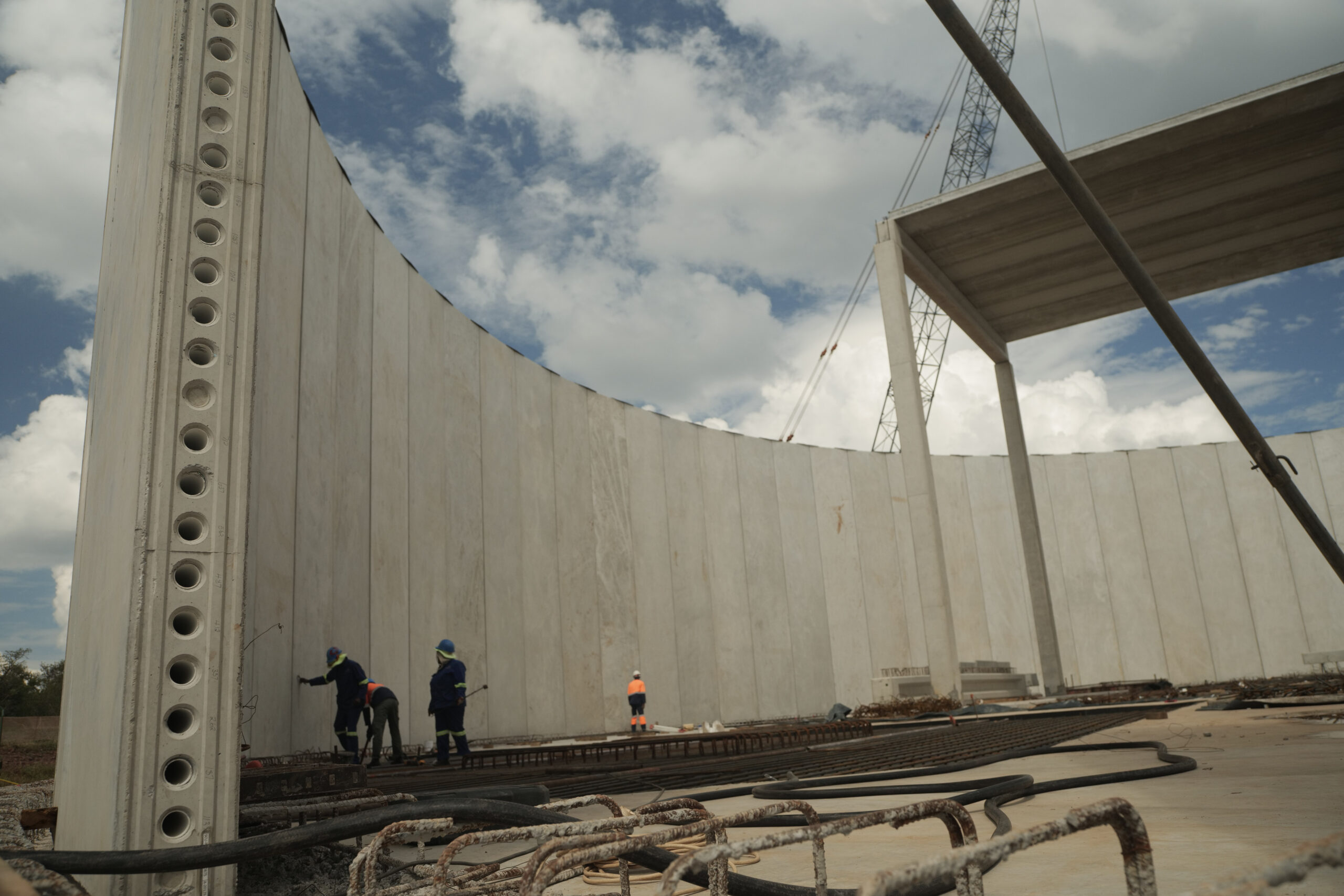
One example of this manufacturing precision is the production of the complex buttress panels used in precast concrete reservoirs. De Jager explains that these panels form the external structural support system for the reservoir walls while incorporating the anchorages and cast-in components required for the post-tensioning system. “Post-tensioning places the wall panels into permanent compression, ensuring both their structural integrity and long-term water tightness,” he says. “The location of every lifting anchor, reinforcing bar, duct, embedded plate and post-tensioning anchorage is therefore critical to both construction and long-term performance.”
Achieving this level of precision consistently on a conventional construction site would be extremely challenging given the constantly changing conditions and the many variables that must be managed simultaneously. Manufacturing the panels in a controlled factory environment allows every component to be positioned accurately using repeatable production processes, purpose-built moulds and rigorous quality control procedures. As is the case with all the elements that make up the system, every panel is thoroughly inspected before leaving the factory. The eliminated the need for on-site modifications and manual intervention while contributing to a safer, more predictable construction process.
Digital precision
Rigging is another area where De Jager believes careful planning significantly enhances safety during the construction of precast concrete reservoirs.
“Every lift is engineered before work begins, with detailed lift plans, certified lifting equipment and purpose-designed lifting points cast directly into the precast elements,” he says. “Crane positions, lifting sequences, load paths and exclusion zones are all established in advance to ensure that each component is installed in a controlled and predictable manner.”
Because the precast elements are manufactured to exact dimensions and lifted directly into their final position, manual handling is minimised and the need for repeated lifting or corrective adjustments is significantly reduced. De Jager says this systematic approach not only improves installation efficiency but also reduces the risks associated with suspended loads, working at height and unplanned site activities.
Corestruc further enhances installation safety through the use of advanced surveying and positioning technology. During the construction of Africa’s first precast concrete water towers, for example, the company deployed fully automated robotic total station technology to guide the precise placement of every structural element.
“Combined with the dimensional accuracy achieved during manufacturing, this technology enables exceptionally tight construction tolerances throughout installation,” he says.
The company’s survey and installation teams consistently achieve dimensional accuracies of 5 mm when installing support columns and beams, while roof tolerances of just 20 mm are routinely achieved at height on precast concrete modular reservoirs. This level of precision ensures that components fit exactly as designed, minimising the need for manual adjustments and reducing the time workers spend guiding suspended loads or carrying out corrective work at elevation.
“By improving accuracy and minimising intervention during lifting operations, digital construction technologies are helping to make precast installation both safer and more efficient,” De Jager concludes.
Safety by sequence
De Jager notes that safety begins long before installation starts. “Every project is engineered to ensure temporary stability throughout the erection sequence, with detailed construction simulations confirming that each precast element remains adequately supported until the permanent structure is complete,” he explains.
This engineering-led approach reduces worker exposure to many traditional construction hazards while shortening construction programmes, reducing site congestion and limiting the amount of work undertaken at height.
The precast roof system is manufactured while the site is still undergoing earthworks and the in-situ floor slab and column bases are being constructed, allowing multiple construction activities to proceed simultaneously and significantly reducing the overall construction programme. Once the column bases are complete, precast columns are erected, followed by suspended beams and hollow-core roof slabs, which are interconnected using cast-in reinforcement and in-situ concrete to form a monolithic structural roof. By constructing the roof in parallel with the early civil works, rather than waiting for the walls and columns to be completed as in conventional cast in-situ construction, Corestruc is able to save months on project delivery.
Once the inner portion of the roof structure has been completed, construction of the reservoir wall begins. The first precast wall panel is positioned on the ring beam and temporarily stabilised using push-pull props. Subsequent panels are connected using steel brackets and braced back to the completed roof structure, significantly reducing the need for extensive temporary propping while providing a stable platform for erection. Post-tensioning cables are then threaded through ducts cast into the panels before the joints are grouted with a high-strength, high-flow grout. Once the grout has reached the required strength, the cables are stressed through the precast buttress panels, placing the wall into permanent compression to provide structural integrity and long-term watertightness. “The wall is then permanently anchored to the ring foundation by casting a reinforced in-situ kicker around its base,” he says.
By comparison, conventional reservoir construction follows a sequential process in which the floor slab is completed first, followed by the walls and supporting columns, before work can begin on the roof. Constructing the roof typically requires extensive formwork, falsework and temporary propping to support the wet concrete until it has gained sufficient strength. Throughout this period, workers must operate at height, install reinforcement, erect and strip formwork, and place concrete, often over several weeks. “These temporary works, together with prolonged on-site activities, increase construction complexity and require rigorous engineering controls to manage the associated safety risks,” De Jager says.
Raising the standard
Despite the proven benefits of structural precast concrete, South Africa still has relatively few suppliers capable of delivering large-scale structural precast solutions. Corestruc believes this presents an opportunity rather than a limitation. Greater adoption of structural precast concrete would expand the country’s capacity to deliver safer, higher-quality and more efficient infrastructure while encouraging continued investment in advanced manufacturing, engineering expertise and modern construction practices. Increased competition would drive innovation, raise standards and ensure that companies continually improve. “Competition keeps everyone striving to do better,” De Jager concludes. “Ultimately, that benefits clients, the industry and, most importantly, the people who build our infrastructure.”